Getting a handmade card is so special. They’re also a great tool in the parenting-toolbox to teach your littles about gratitude and genuine appreciation to create something from scratch, from the heart, just to say “thank you” in a handmade card.
You can just tell. The colors someone picked, the little details they added, the fact that they actually sat down and made something instead of grabbing whatever was closest to the checkout line it all comes through. Handmade cards get saved. Store-bought ones usually don’t. Making cards is one of those crafts that sounds like a small hobby and then slowly takes over a corner of your house in the best possible way.
The part that trips most beginners up isn’t the actual card making. It’s walking into a craft store or falling down an online rabbit hole and having absolutely no idea what to buy first. Stamps, ink, cardstock, dies, adhesive, embellishments, tools, it’s a lot. And a lot of it looks useful even when you don’t fully understand what it does yet.
Here’s the thing though: you genuinely don’t need much to start making cards you’re proud of. These are the supplies that actually matter.
Cardstock
Everything starts here. Regular printer paper is too thin and too floppy, it buckles when you fold it and doesn’t hold up once you start layering things on top. Cardstock is thicker, folds cleanly, and gives your finished cards enough structure to actually feel like cards rather than slightly decorated paper.
Start with a mix of neutrals white, cream, kraft, light gray because those work as card bases and backgrounds for basically everything. Then grab a handful of colors you’re genuinely drawn to. Not colors that seem like they’d probably be useful. Colors you actually like. That distinction matters more than it sounds, because supplies you love looking at are supplies you actually use.
Don’t go overboard right away. A small, curated cardstock collection gets reached constantly. A giant pack of colors that are just okay sits in a drawer.
Patterned paper
This is the beginner’s secret weapon and not enough people talk about it that way.
A strip of really beautiful patterned paper layered across a plain card base immediately makes the whole thing look intentional and put-together no complicated technique required, no advanced skills needed. The paper does the heavy lifting. You just cut it and stick it down.
Buy patterned paper you genuinely love rather than paper that seems generally versatile. If you’re into bold bright colors and fun prints, get that. If soft florals and muted tones are more your thing, get that instead. Cards feel most personal when the supplies behind them actually reflect your taste, so this isn’t the place to be practical about it.
Build this collection slowly. A few sheets you’re excited about will get used way more than a giant stack of paper that’s only kind of okay.
Adhesive
Nobody’s favorite topic but worth getting right from the start.

Bad adhesive causes problems that are quietly maddening things that bubble slightly, don’t hold at the edges, or leave a shiny patch visible through thin paper. None of these are disasters on their own but they’re the kind of thing you stare at for the entire rest of the project.
An adhesive runner is the workhorse for most cards making flat, clean, no mess, holds well. Glue dots are better for heavier things like gems or buttons that need more grip. Foam squares are the move for adding dimension stick them under a shape instead of flat adhesive and it pops up off the surface in a way that looks genuinely impressive for about two seconds of extra effort.
Start with an adhesive runner and a pack of foam squares. That covers most situations.
A paper trimmer
Cutting a straight line across cardstock with scissors is harder than it looks. It almost never comes out perfectly even, and once everything is layered together on a finished card, a slightly off edge becomes the only thing you see.
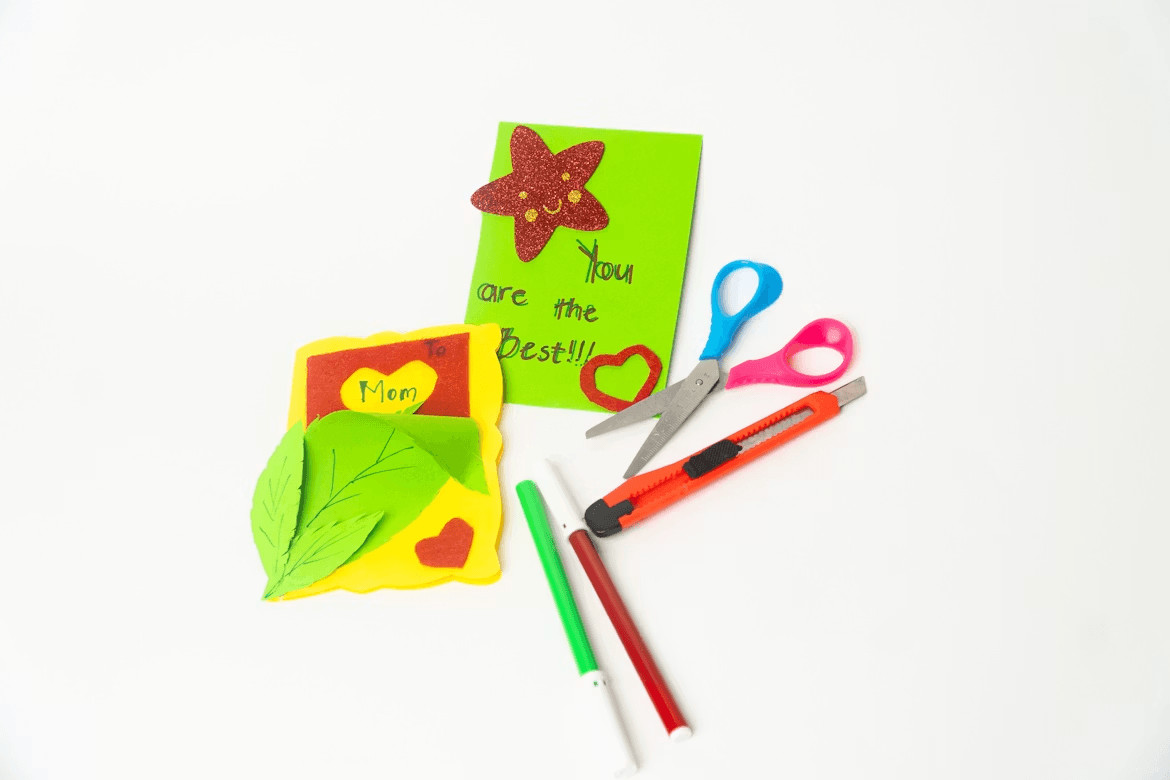
A paper trimmer has a fixed track, you line up your paper, slide the blade, straight cut every time, no holding your breath. For beginning card makers it’s one of those purchases where the before and after difference in how polished everything looks is pretty immediate.
A small pair of detailed scissors is still useful for trimming around shapes and cutting smaller pieces. But for anything that needs a clean straight edge, a trimmer is just the better tool.
Stamps and ink
Stamping is where a lot of card makers fall completely in love with the hobby, and it’s not hard to see why. One stamp set used a hundred different ways across dozens of cards, different ink colors, different papers, different layouts. The versatility is genuinely impressive once you start exploring it.
For beginners, sentiment stamps are the most immediately useful phrases like “happy birthday,” “thank you,” “thinking of you” that you’ll reach for constantly no matter what style of card you’re making. A floral or botanical set is a close second because it works across almost every occasion and aesthetic.
For ink, dye ink dries fast and plays well with most paper surfaces, which makes it the most forgiving option when you’re still figuring things out. Black is always useful. Beyond that, pick two or three colors that fit the kind of cards you want to make and build from there.
Embellishments
The small stuff that makes a card feel finished rather than almost finished. Enamel dots, gems, ribbon, washi tape, stickers, die cut shapes, little chipboard pieces add color and texture and dimension in ways that are hard to achieve otherwise.
Buying too many embellishments too fast is one of the most common beginner mistakes, mostly because they’re small and fun and inexpensive enough that it’s easy to rationalize. But a huge jumbled embellishment collection is genuinely harder to use than a small organized one, because you spend so much time digging through it that you give up and use whatever’s on top anyway.
Pick a few things that fit your style. A small set of enamel dots in colors you love. A couple of washi tape rolls in patterns that appeal to you. Maybe a pack of gems. Use those up, see what you reach for constantly, then add more based on that. You can browse card making supplies here once you have a sense of your direction.
Getting your storage sorted early
Not a supply exactly, but skipping this step early creates real problems later.
Supplies that are disorganized don’t get used and more specifically, supplies you can’t see don’t get used. Paper stacked in a pile means the bottom half might as well not exist. Embellishments all mixed together in one bin become a dig-through every time you need something. Inks stored facing the wrong way mean you end up using the same three colors because those are the ones you can actually identify.
Simple storage works perfectly fine. Clear bins. A vertical holder for paper so you can flip through it. Small divided containers for embellishments sorted by type or color. Nothing elaborate just visible and grabbable.
On building your collection
Slow is better than fast here, even though that’s not what the craft store experience encourages.
It’s easy to buy supplies faster than you use them, especially when everything looks exciting and potentially useful. A paper collection that caught your eye. A stamp set that seemed versatile. An embellishment pack on sale. And then you get home and realize you’ve spent a bunch of money on things you don’t quite know what to do with yet.
Make some cards first. See what you naturally reach for. Notice which techniques feel satisfying and which ones you skip. Then buy supplies that support what you’re actually doing rather than what you imagined you might do.
Most experienced card makers will tell you they have a small set of supplies they use constantly and a much larger collection of things that looked great in the store and have barely been touched since. Building slowly is how you end up with mostly the first kind.
The gap between “I’ve never made a card” and “I just made something I actually love” is smaller than most people expect. You don’t need an impressive supply collection or advanced techniques or a dedicated craft room. You need a few good basics, some cardstock you like, and enough curiosity to try things and see what happens.
The rest figures itself out pretty quickly.