Every parent watches their child reach for words, and every parent feels the small ache when those words come out tangled or missing altogether. Communication is how a child asks for help, shares a joke, and tells you what hurt at school. When it comes easily, family life flows. When it does not, ordinary moments turn into quiet frustration for the child and worry for the adults around them.
The good news is that supporting a child’s communication is not something reserved for clinics and appointments. It happens at the breakfast table, on the walk home, and in the middle of a game on the living room floor. Small, steady habits add up, and parents are often the most powerful influence a child has.
Understanding What a Speech Professional Actually Covers
Parents who worry about a child’s speech often think about consulting a speech pathologist but stop short, unsure whether their concern is even the kind of thing such a specialist handles. Many assume the job is limited to fixing a few mispronounced letters, so they wait, and that delay costs the child years when early help would have made the biggest difference. Once a parent sees the full scope of practice in speech language pathology, the decision to reach out becomes far clearer.
That range covers speech sounds, understanding and using language, the flow and rhythm of speech, voice quality, and the social skills needed to hold a conversation. It also reaches into feeding, swallowing, and the thinking processes that support memory and attention during communication. A specialist assesses each of these, diagnoses what is happening, and builds a plan suited to the individual child. Knowing how broad that coverage is helps a parent recognize when a concern is worth raising rather than brushing aside.
Talking Through Everyday Moments
The most natural language lessons hide inside ordinary routines. A child learns words by hearing them attached to real objects and real actions, over and over, without pressure. Narrating what you do together turns a quiet chore into rich language input.
Cooking dinner becomes a chance to name ingredients, describe textures, and count spoons. Folding laundry lets a child sort colors and match pairs while you talk through each step. A trip to the store offers a running conversation about what you see, what you need, and what comes next. None of this requires special materials. It only asks that you speak with your child rather than around them, and that you leave space for a reply.
Listening Like It Matters
Children speak more when they feel heard. When a child senses that an adult is truly paying attention, the reward encourages them to try again and to reach for harder words next time. Rushing a child or finishing their sentences teaches the opposite lesson, that talking is not worth the effort.
Get down to eye level when your child speaks. Put the phone aside, wait out the pauses, and resist the urge to correct every small mistake. If your child says something unclear, repeat it back in its correct form as a gentle model rather than a lecture. This quiet approach keeps the conversation warm and keeps the child willing to keep going.
Reading Together Every Single Day
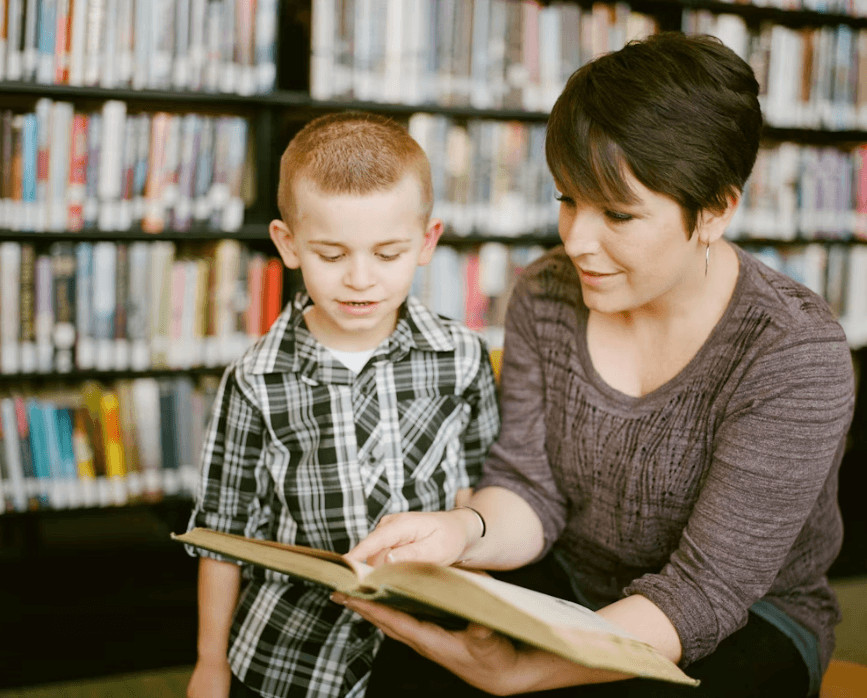
Few habits build language as reliably as reading aloud. Books introduce words a child would rarely meet in daily chatter, and they wrap those words in stories that make them stick. Reading and storytelling can also be an important part of a day in the life of a kindergarten student, giving children regular opportunities to hear new words and express their own ideas. A shared book also slows everyone down and creates a calm pocket of connected time.
You do not need to read every word on the page. Point at pictures and ask what your child sees. Pause before a familiar ending and let your child fill it in. Ask what might happen next and follow their guess wherever it goes. These small invitations turn reading from a quiet performance into a two-way exchange, and that exchange is where language grows.
Playing With Purpose
Play is a child’s natural workshop for words. Pretend games ask a child to invent characters, describe actions, and negotiate rules, all of which stretch language in ways that feel like fun rather than work. Building blocks, dolls, toy kitchens, and simple board games each open different kinds of talk.
Follow your child’s lead during play instead of directing it. If your child hands you a toy phone, answer it and start a conversation. If a tower falls, talk about why and what to try next. Board games add turn-taking, waiting, and the language of winning and losing gracefully. The goal is not to teach during play but to talk during play, letting words flow naturally from the activity itself.
Building Confidence Through Patience
A child who fears getting it wrong will often choose silence. When mistakes are met with correction or impatience, the child learns to hold back, and that hesitation can harden into a lasting habit. Confidence, on the other hand, invites a child to take risks with new words and longer sentences.
Praise effort rather than perfection. Celebrate the attempt even when the result is messy, and treat errors as an ordinary part of learning rather than something to fix on the spot. Give your child time to gather their thoughts, and let them lead the topic toward things they care about. A child who feels safe experimenting with language will experiment far more, and every attempt strengthens the next.
Knowing When to Ask for Help
Trusting your instincts matters. If your child seems far behind other children their age in understanding or using words, or if communication feels harder than it should for the whole family, it is worth reaching out. Early support tends to work better than delayed support, and no parent needs to wait until a small concern becomes a large one.
A pediatrician or a school can point you toward an assessment, and a specialist can tell you whether everyday strategies are enough or whether more structured help would serve your child better. Asking is not an admission of failure. It is simply one more way of giving your child the tools to be understood.
Helping a child communicate is less about grand efforts and more about the thousands of small, warm exchanges that fill an ordinary week. Talk, listen, read, and play, and your child will feel both the words and the love behind them.