Decluttering has a reputation problem, and it’s twice as bad when there’s a family involved. Mention it to most parents and you’ll get a slightly pained look, considering the promise of a calmer home… that demands a weekend of exhaustion, three arguments about a broken toy, and a garage that somehow ends up fuller than it started.
The headache most families associate with decluttering usually isn’t the sorting itself. It’s the lack of a plan, the ‘tossing out’ guilt, the negotiation over whose things go, and the mountain of “stuff” that has nowhere to go. Approach it differently, and decluttering becomes far less draining. The problem is rarely a lack of motivation. It’s that most households start without a system, get overwhelmed halfway through, and end up with more mess than they began with.
Here’s how to get your family through it without anyone becoming overwhelmed.
Start With a Plan, Not a Room
The instinct when decluttering is to pick a room and dive in. That’s often exactly what leads to burnout, especially in a shared home where every room belongs to everyone. Pulling everything out of the hallway cupboard with no real system and finding the family surrounded by piles hours later is a recipe for giving up halfway through.
Instead, start smaller and more structured:
- Pick a category, not a room. Toys, kids’ clothes, books, kitchen gadgets, school paperwork. Categories are easier to judge consistently than a room full of mixed items, and they’re easier to hand to a child as a clear job.
- Set a time limit. An hour is enough to make real progress without burning out. Shorter still for younger kids — twenty minutes of focused sorting beats a whole afternoon of resistance.
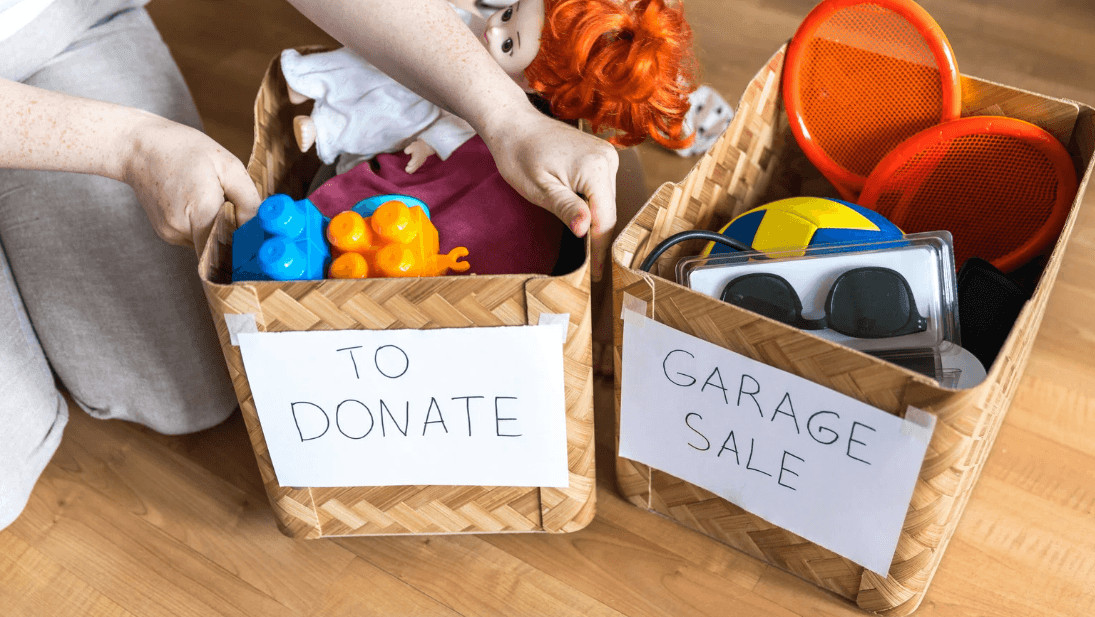
- Decide your sorting piles. Plan your piles for “keep”, “donate”, “sell”, “recycle”, and “rubbish”. Having set piles means nobody is making a new decision every single time they pick something up.
- Have a destination for each pile. This is the step most people skip, and it’s the one that causes the most stress later.
That last point matters more than you think. A “declutter” that ends with five bags sitting in the garage for three months isn’t actually finished. It’s just relocated — usually to the exact spot the kids’ bikes are meant to live.
Getting the Kids Involved (Without a Meltdown)
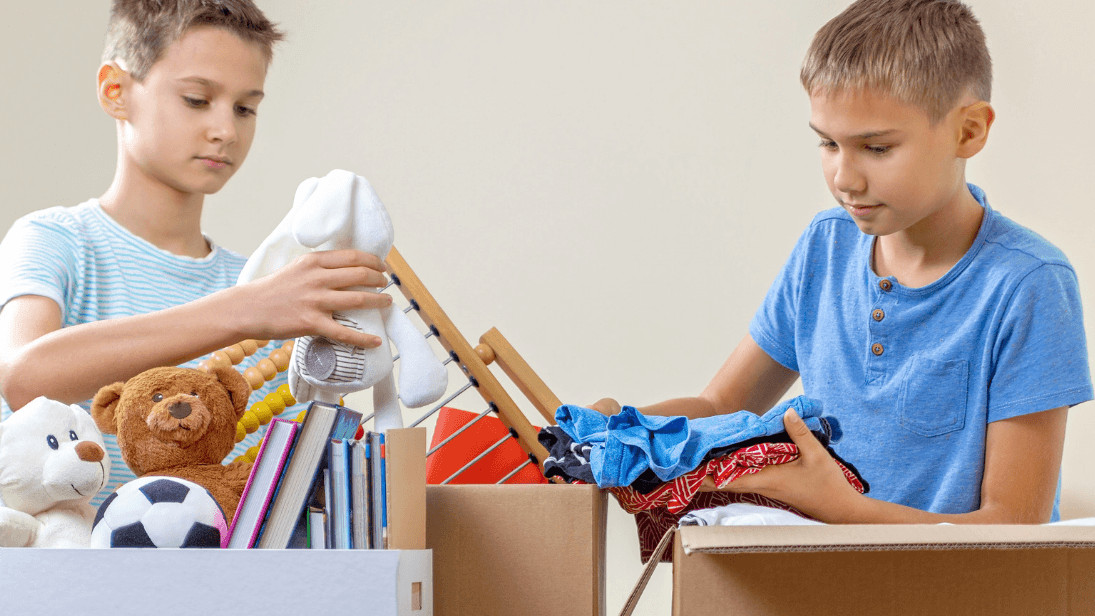
Children hold on to things far more tightly when decisions are made for them. Bringing them into the process, in a way that suits their age, turns decluttering from something being done to them into something they get a say in.
- Give them a job with a boundary. “Fill this one box with toys you’ve outgrown” works far better than “go through your room”. A single container is a finish line they can see.
- Sort clothes by fit, not feeling. Try-on sessions are quick and unemotional. If it doesn’t fit, it goes — no debate required.
- Let them choose where things go. Deciding that a toy is going to another child who’ll enjoy it gives the decision a purpose, and takes the sting out of letting go.
- Keep a small non-negotiable pile. Every child gets a handful of things nobody is allowed to question. It costs you almost nothing and buys enormous cooperation on everything else.
Tackling the Shared Spaces
Bedrooms are the easy part, because everyone knows whose things they are. It’s the living room, the playroom, the hallway, and the garage where family decluttering usually grinds to a halt — nobody owns the clutter, so nobody wants to make the call on it.
Do these rooms together, with everyone present, so decisions can be made on the spot rather than parked. Work surface by surface rather than corner by corner, and give every category of item that lives in the room a defined home before you finish. A shared space stays tidy only when everyone in the house knows where things are supposed to go back to.
The Real Source of Decluttering Fatigue
Most decluttering guides focus heavily on the decision-making part: what to keep, what to toss, how to be honest about what the family actually uses. That’s genuinely useful, and our guide to upcycling inspiration for your family shows how to repurpose, recycle and give a second life to things you’d otherwise throw out, rather than sending everything straight to landfill.
There’s another, quieter source of fatigue that rarely gets addressed: the physical weight of it all. Outgrown cots and prams, a broken bunk bed, years of accumulated boxes, a mattress nobody wants, garden waste from a yard clean-up. These items don’t fit neatly into a donation bag, and they’re often too bulky or awkward for one parent to deal with alone. This is usually where a family declutter stalls, actually. The sorting gets done, and then everything sits in a pile because nobody wants to spend three trips to the tip hauling it away in the back of the car.
Where Outside Help Actually Earns Its Keep
If you’re in Australia and facing a clean-up that involves genuine bulk, whether that’s a full house declutter, a move, a deceased estate, or simply years of accumulated family furniture and junk, a professional rubbish removal from 1300Rubbish handles the physical side entirely: the lifting, the loading, and the responsible sorting of what can be recycled versus what actually needs to go to landfill.
Not only is a removal service convenient, but it also saves the whole household from the emotional weight of constant decision-making. A lot of decluttering fatigue comes from staring at a pile of “stuff” that represents unfinished business. Once that pile is physically gone from the house, the mental relief can be immediate — and the kids get their floor space back the same day.
Make Room for the “I’m Not Sure” Pile
One habit that quietly derails a lot of family decluttering sessions is forcing an immediate yes-or-no decision on every single item. Some things genuinely need more thought than an hour’s sorting session allows, and children in particular need time to let go. Rather than let that stall the whole process, give the household a fifth pile: “maybes”.
Box it up, label it with whatever date it will be in three months, then put it somewhere out of the way. If nobody has thought about it, needed it, or missed it by that date, it’s an easy donate or discard decision. This one extra pile removes an enormous amount of decision fatigue, because you stop treating every decision as a permanent, irreversible choice. It also acts as a safety net for indecision, which is often the exact thing that causes a family to abandon a declutter partway through.
Keeping It From Piling Up Again
With how exhausting this process can be, you don’t want to repeat it every few months. As our piece on easy storage ideas that help kids stay organised points out, lasting order comes from small, steady habits rather than the occasional giant clean that leaves everyone wiped out and back where they started within a year.
The habits that work best in a family home are the simple ones everybody can remember. A one-in, one-out rule on toys. A ten-minute tidy before dinner where everyone takes a room. A donation box that lives permanently in the laundry, so outgrown clothes go straight in rather than back into a drawer. A short seasonal check-in before birthdays and Christmas, when new things are about to arrive anyway. Treat it as an ongoing rhythm instead of a one-off crisis.
The Takeaway
Decluttering doesn’t have to be a headache, even with a full house. It becomes one when there’s no plan for the decisions, no destination for the piles, and no help for the physical bulk that inevitably builds up. Break the process into manageable sessions, bring the kids in with clear and age-appropriate jobs, give everyone a genuine “maybe” option, get help for the heavy lifting, and build small maintenance habits afterwards so you’re not starting from scratch again next year.
Do that, and decluttering stops being the dreaded weekend project and starts being another manageable part of keeping a calm family home.