Comics are a great starting point for kids’ creative projects because they bring together drawing, reading, and storytelling. Kids of different ages can enjoy them, and they also have one major advantage: they encourage children to read. That matters even more now, when many kids split their attention between screens, games, and short-form content.
Why Do Comics Make It So Easy to Get Kids Interested in Creativity?
Comics make it easy to get kids interested in creativity because they do not have to write a long text or draw a complicated illustration right away. Everyone knows how hard it can be to start a complex project. Here, one character, one scene, and one funny line are enough. The child already feels like they have created something.
Comics are also convenient because they break a story into small parts. A child does not have to think through everything at once. They can draw a character first, then add a line or an action, and only after that come up with the ending. This step-by-step approach often takes away the fear of starting something big. It helps even kids who do not really like writing long texts get started.
Comics have another strong side – they combine words and pictures. A 2025 study from the American University of Sharjah shows that this format helps expand a child’s vocabulary. That happens because kids work with visual and verbal information at the same time. A child does not just read a word. They also see it in action, in a scene, and in a character’s emotion.
This matters for another reason too. According to the National Literacy Trust’s 2026 report on children and young people’s reading, only 36.1% of children and teenagers aged 8 to 18 said they enjoyed reading in their free time, and only 20.3% read something every day.. That is why anything that makes reading feel closer to play really matters.
Kids are often afraid to start creating something right away. That is why it helps to have a few sources of inspiration:
- Children’s library section;
- Beginner comics, webtoons, and graphic novels;
- Family photos for making your own stories.
The main thing is not to copy someone else’s story. It is better to ask the child to notice something interesting in each comic, something that inspires them.
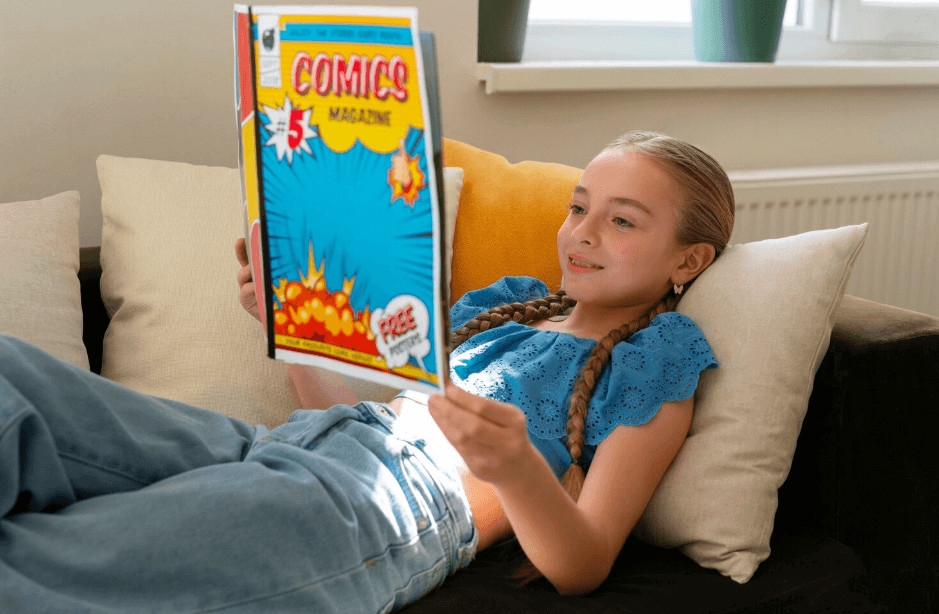
Five Comic-Inspired Creative Projects That Are Easy to Make at Home
Comic-based creative projects are easy to do because they don’t need costly materials. They are also adaptable to the child’s age. The main things here are practice and simple ideas that children can make themselves.
Draw Your Own Mini Comic
The easiest place to begin is a mini comic, as a child can see the finished product very quickly. They only require a folded piece of paper, a pencil or markers and, if they wish, a ruler for the panels. Before drawing, it can help to explore different storytelling formats through books, printed comics, or platforms like Honeytoon, an online comics library in English with a web reader and mobile app. What this helps with:
- An understanding of sequence;
- Practice with short sentences;
- Imagination development.
Recommended age: for older kids and parents reading along.
Make Characters Out of Cardboard
Cardboard characters work well for children who prefer to create something rather than sit down and write right away. You need cardboard, scissors, glue, markers, and any leftover materials for decorating: thread, scraps of paper, or buttons. What this develops:
- Fine motor skills;
- Visual thinking;
- The ability to create a character’s look.
If the character is already in front of them, it is much easier to come up with a story. The child can see what the character looks like and understand what might happen to the character.
Make a Story Cube
A story cube is a game that can be used when a child is unable to think of a story. You can draw a character, a place, a problem, a helper, an object, and an ending on its six sides. Materials:
- A paper or cardboard cube;
- Markers;
- Stickers or simple drawings.
The recommended age is 6 years and older. This project is excellent for imagination and for a child to learn how to create a story from individual components. It also relieves the pressure since the child doesn’t have to come up with everything on their own.
Make Puppets With Character Speech Bubbles
Children who enjoy talking, performing, and acting out scenes will benefit from puppets with speech bubbles. You will need paper circles or cut-out characters, sticks, glue, and little speech bubbles for this. This format develops:
- Speech;
- Dialogue;
- The ability to show emotion.
The important thing here is that the child can say the scene out loud first, and then make it into a comic. This is easier and more natural for many children than writing something down.
Draw a Family Comic About One Day
A family comic is good because the child doesn’t have to create an entire universe. A real event can be used as the base. Discuss with your child a shopping trip, a picnic, a birthday party, or a funny thing that happened at home.
Any story that befell the child can be the basis for a comic. This is particularly helpful for younger children as they can use familiar family moments to create simple projects.
FAQ
At What Age Can a Child Start Making Comics?
Children can start at around 5–6 years old. Of course, adults should help with captions, panels, and the storyline. At this age, a child does not need to write a lot. Drawings, short lines, and a simple chain of events are enough.
Do Comics Help Children Who Do Not Really Like Reading?
Yes, they often do. Comics give children shorter pieces of text, strong visual support, and a clear reason to keep reading. A child can follow the story through pictures first, then connect the words to actions, emotions, and small details in each panel.
What Materials Do You Need for a First Comic at Home?
For a first comic at home, paper, pencils, markers, and scissors are usually enough. Families can also use folded paper, cardboard, glue, stickers, or old magazines. The project does not need expensive supplies, because the main goal is story practice, not perfect artwork.
Can Comics Be Used in Homeschooling?
Yes, comics can work well in homeschooling because they combine reading, writing, story building, and visual thinking. Children can practice vocabulary, sequence, dialogue, and cause-and-effect in one activity. They also make lessons feel less formal, which can help reluctant readers stay involved.
How Many Pages Should a Child’s First Comic Have?
It is better to start with 4–6 panels or one small folded booklet. For a first try, the important thing is not to make it a “big project.“ The main goal is to help the child finish it. When a child sees a completed result, they are more likely to want to make the next story.