Children don’t just need smaller versions of adult mattresses. They need mattresses that account for the fact that their bodies are changing faster than at any other point in their lives, that they sleep longer and more actively than adults, and that the mattress will need to handle everything from night-time accidents to the occasional bouncing session that no parent manages to prevent entirely.
The UK kids’ mattress market has improved significantly in recent years. Where children’s mattresses were once an afterthought, built cheaply and expected to be replaced quickly, a number of manufacturers now apply the same engineering principles to children’s sleep surfaces that they use for adults. The result is a generation of kids’ mattresses that provide genuine spinal support, temperature regulation, and durability rather than simply being thin foam slabs in a smaller size.
What Should a Kids’ Mattress Actually Do?
A child’s spine is still developing, and the mattress plays a direct role in how it aligns during the hours of sleep that make up a large proportion of their day. A toddler sleeps 11 to 14 hours; a primary school child sleeps 9 to 12. On a mattress that sags, creates pressure points, or fails to support the natural curvature of the spine, those hours compound into postural issues that may not become apparent until years later.
Beyond spinal support, temperature regulation matters more for children than most parents realise. Children have a higher metabolic rate relative to their body size, which means they generate more heat per kilogram than adults. A mattress that traps that heat creates restless sleep, night sweating, and the kind of frequent waking that exhausts the entire household.
Durability is the practical concern. Children are not gentle with mattresses. The surface needs to withstand active use while maintaining its support properties across years of growth and weight change.
For Babies and Toddlers: The Simba Hybrid® Cot Bed Mattress
The transition from cot to toddler bed is the first point where mattress quality makes a measurable difference. For babies under 12 months, The Lullaby Trust recommends a firm, flat sleep surface, and the mattress must meet BS EN 16890, the UK safety standard for cot and crib mattresses.
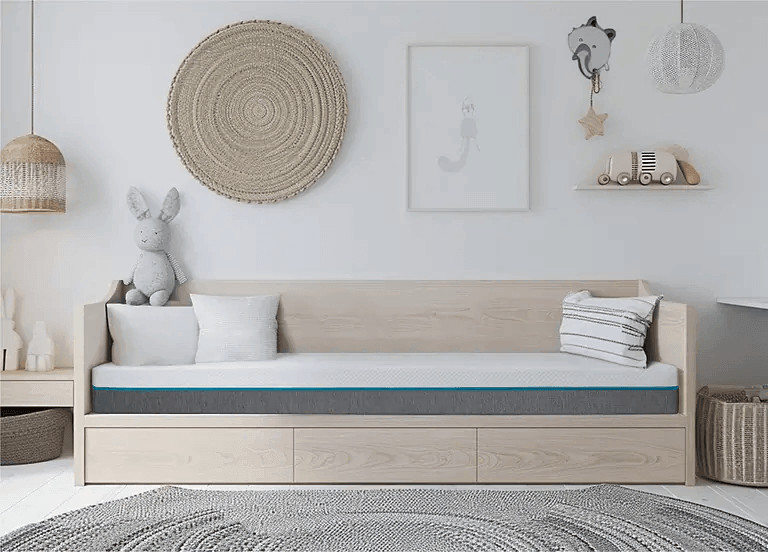
The Simba Hybrid® Cot Bed Mattress addresses both stages of early childhood with a dual-sided design. The firmer side provides the flat, supportive surface that newborns require, meeting all BS EN 16890 safety criteria. When the child passes 12 months, the mattress flips to a softer toddler side that offers more cushioning while still providing edge-to-edge support.
What sets it apart from basic cot mattresses is the inclusion of Aerocoil® pocket springs, the same patented spring technology found across Simba’s adult Hybrid® range. The springs respond independently to pressure, which means they adapt to the child’s weight and movement rather than creating a uniform surface that doesn’t account for how a baby or toddler actually lies. The mattress also includes a water-resistant inner lining to protect the spring and foam core from liquid damage, and the outer cover is removable and machine washable.
For Older Children: The Simba Hybrid® Kids Mattress
Once a child has moved into a single bed, the mattress requirements shift. The sleep surface needs to provide genuine support for a growing skeleton, handle increasing body weight over several years, and fit safely within standard UK bunk beds and cabin beds if that’s the bedroom setup.
The Simba Hybrid® Kids Mattress uses the same Aerocoil® titanium alloy microsprings and Simbatex® graphite-infused foam found in the adult range, in a shallower depth that meets safety regulations for raised beds. The Simbatex® foam is designed to promote airflow and conduct heat away from the body, which addresses the temperature regulation challenge that children’s higher metabolic rate creates.
The cover is zip-off and machine washable, which matters enormously for a child’s bed where spills, crumbs, and general mess are inevitable. The pocket spring construction provides responsive, independent support that adapts to the child’s body as they grow, rather than requiring a mattress replacement every time their weight changes significantly.
What to Look for in Any Kids’ Mattress
Regardless of brand, the features that matter most in a children’s mattress are:
- Pocket springs over foam-only construction. Independent springs provide responsive support that adapts to a growing body. Foam-only mattresses compress permanently under repeated use and lose their support properties faster.
- Breathable materials. Open-cell foam and spring ventilation prevent the heat buildup that disrupts children’s sleep. Avoid sealed waterproof covers that trap heat; a water-resistant inner lining with a breathable, washable outer cover is the better approach.
- Washable cover. Children’s mattresses get dirty. If you can’t remove and wash the cover, you’re relying on surface cleaning that doesn’t address what’s underneath.
- Appropriate depth for the bed frame. Bunk beds and cabin beds have guard rail clearance requirements. A mattress that’s too deep reduces the effective height of the guard rail and compromises safety.
FAQs
At what age should a child move from a cot mattress to a single mattress?
Most children transition between ages two and three, depending on their size and development. If the child is climbing out of the cot or has outgrown the cot bed dimensions, it’s time to move to a single.
Can a child use an adult mattress?
Yes, provided it’s an appropriate size and firmness. A quality single mattress from an adult range, like Simba’s Hybrid® models, provides better support than a cheap “children’s” mattress with inferior construction.
How often should you replace a kids’ mattress?
Every five to seven years, or sooner if the child’s weight has increased significantly or the mattress shows visible sagging. Children’s mattresses wear faster than adult ones due to more active use.
Do children need a mattress protector?
Yes. A waterproof, breathable protector prevents liquid damage, extends mattress lifespan, and makes cleaning up after accidents straightforward. It’s one of the most cost-effective investments in children’s sleep hygiene.
Is a firmer or softer mattress better for children?
Medium-firm suits most children over the age of three. Very soft mattresses allow the spine to sag; very firm ones create pressure points. A pocket spring mattress with a foam comfort layer naturally provides the medium-firm support that growing bodies need.