I’ve learned that one of the easiest ways to teach kids about time is to give them something they actually want to finish.
A birdhouse might look like a one-hour project. Then measuring takes longer than expected. A board needs another cut. The first coat of paint isn’t dry when you thought it would be. Suddenly, that one-hour project is pushing into the afternoon.
I don’t see that as a problem. It’s part of the project.
Building things gives kids a chance to experience time instead of just hearing an adult tell them to “manage it better.” They find out that some jobs take five minutes, others take 30, and almost every project has a surprise somewhere along the way.
Here are a few things that have worked for us.
Start With a Project You Can Finish
For teaching time management, I prefer a project that kids can finish in an afternoon.
A planter, birdhouse, painted storage box, wooden sign, or cardboard creation gives us enough steps to make a plan without turning the project into a month-long commitment.
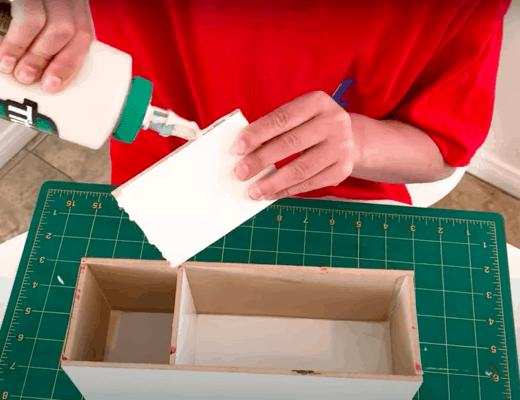
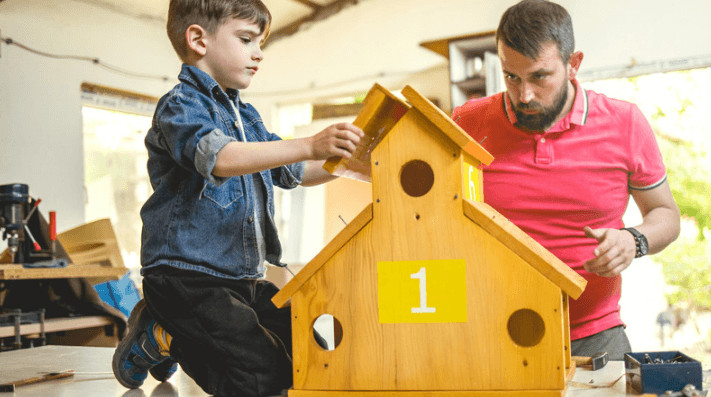
Something like this modern birdhouse project is a good example. Kids can see how measuring, cutting, sanding, assembling, and finishing all have to happen in a certain order.
Before we pick up the tools, I start asking questions.
What should we do first? What needs to happen before we can paint? Is there anything we can prepare now that will save us time later?
I try not to provide all the answers. I’d rather have the kids work out the order themselves.
Break the Build Into Smaller Jobs
“Build a birdhouse” sounds simple until you start listing everything involved.
There are materials to gather, measurements to make, cuts to mark, pieces to assemble, edges to sand, and paint to apply. And yes, cleanup counts.
For a basic project, our list might look something like this:
- Gather tools and materials.
- Measure and mark.
- Cut or assemble the pieces.
- Sand rough surfaces.
- Paint or decorate.
- Let everything dry.
- Add finishing touches.
- Clean the workspace.
I like having kids help make the list rather than handing them one that’s already finished. It gets them thinking about the build before we start it.
There is a good reason to let kids help make the plan. The Center on the Developing Child at Harvard University points to planning as one way children can practice executive function skills.
In the workshop, we don’t need to call it executive function. We’re just figuring out what happens first, what can wait, and when we can finally open the paint.
Guess How Long Each Job Will Take
This is one of my favorite parts because the answers can be wildly optimistic.
How long will sanding take?
Five minutes.
How about painting?
Maybe 10.
And cleanup?
Definitely five.
I write down the guesses and resist the urge to correct them. Then we see what actually happens.
Sanding for five minutes can feel endless to a kid, while decorating a finished project can somehow eat up half an afternoon. After a few builds, the guesses usually start getting closer.
Put the Kids in Charge of the Clock
If I’m not careful, I become the unofficial clock during a family project.
“We have 20 minutes left.”
“It’s almost lunchtime.”
“We need to wrap this up.”
So we check the time before starting a job and figure out when we should check it again. Younger kids can use a kitchen timer or wall clock. Older kids can practice reading an analog clock and calculate when 10, 20, or 30 minutes will have passed.
My kids know I’m usually wearing a Japanese Seiko Watch, so sometimes I’ll just hold out my wrist and ask what time it is. Then comes the harder question: “If we give this 20 minutes, what time should we stop?”
Before long, they’re checking the time instead of waiting for me to announce it. An analog wristwatch works especially well for this because the hands give kids a visual way to see time passing. Many Seiko watches use a traditional dial with hour, minute, and second hands, so I can ask the kids to find the minute hand, read where it is now, and work out where it will be 20 minutes later. It turns the watch on my wrist into a simple tool for practicing time without interrupting the project.
Take a Break at the Right Time
I’ve learned not to wait until everyone is tired and frustrated before suggesting a break.
For longer builds, we look for a natural stopping point. We might finish sanding a board, put on the first coat of paint, or complete one part of the assembly before stepping away.
Paint drying is practically an invitation to take a break. Grab a snack, get some water, or spend a few minutes outside.
There is evidence for getting kids moving during breaks, too. The Centers for Disease Control and Prevention notes that classroom physical activity can support concentration, on-task behavior, motivation, and engagement.
I also let the kids have some say in when we stop. Sometimes they want the break. Other times they would rather finish the piece in front of them first.
Faster Isn’t Always Better
Put kids in charge of the clock and there’s a chance they’ll decide faster must be better.
DIY usually corrects that idea pretty quickly.
Glue needs time to set. Paint needs time to dry. Measuring twice takes longer than measuring once, but it can save you from cutting another board.
I’ve seen enough projects go sideways to know that saving three minutes now can easily cost 20 minutes later.
When we have to wait, we find another small job. Wash the brushes. Put away tools we’re finished with. Sweep up some sawdust. Get the next piece ready.
There’s almost always something to do.
Leave Some Wiggle Room
I don’t remember many DIY projects where everything happened exactly as planned.
A screw goes in crooked. A measurement is wrong. We’re missing a nail. A piece doesn’t fit the way it did in our heads.
If I think a project needs two hours, I don’t plan the afternoon down to the minute.
And when something goes wrong, I try not to quietly fix the schedule myself.
“How much longer do you think this will take?”
“Can we do something else while we fix this?”
“Do we still have time to finish today?”
Sometimes we finish later. Sometimes part of the build waits until tomorrow.
Save 15 Minutes for Cleanup
Kids and adults don’t necessarily have the same definition of “finished.”
The birdhouse may be done, but the drill is still on the bench, scraps are on the floor, and somebody left the paint open.
I try to reserve the last 10 or 15 minutes for cleanup. If we’re stopping at 4 p.m., the actual building probably stops around 3:45.
Kids can collect scraps, put tools back, close containers, wipe down the bench, and sweep the floor. A workshop is much easier to clean when everything has a home, which is why these tool storage ideas for building projects with kids can be useful.
I like ending with a clear bench. It makes starting the next project much easier.
Compare the Plan With What Actually Happened
I don’t turn the end of a project into a performance review.
Usually, I’ll ask a couple of questions while we’re looking at what we made.
What took the longest?
What was easier than you thought?
What slowed us down?
What should we do differently next time?
Sometimes the answer is obvious. We underestimated sanding. We forgot about drying time. We spent 30 minutes choosing paint colors.
We remember that when we plan the next one.
Hand Over More Control With Every Build
At first, I might decide what we’re building and how much time we need. The kids can help make the checklist.
On the next project, they can estimate how long each job will take.
Later, they can decide when we need to start, where a break makes sense, and when it’s time to stop building and start cleaning.
A project might take twice as long as they predicted. They might forget a step. The decorating might become a much bigger production than expected.
I’d rather have them discover that for themselves than have me manage every minute.
The Project Doesn’t Have to Finish on Time
Building things teaches kids how to measure, cut, paint, solve problems, and use tools safely. It also gives them a much better sense of what time feels like when there’s a real job to finish.
That’s why I like starting with something we can tackle in an afternoon.
We make a list. We guess how long things will take. We check the clock. We adjust when something goes wrong.
And something usually does.
If the birdhouse isn’t finished exactly when we predicted, that’s fine. We’ll have a much better idea of how to plan the next one.